
Freezer · All brands
Freezer Repair in San Diego
In-home freezer repair across San Diego County, from Oceanside to Chula Vista, for every major brand. Same-day visits when the schedule allows.
Or book online and we'll get back to you to set a visit window.
Schedule Your Repair
Four quick steps. We'll confirm a visit window with you, and you'll get a written estimate before any work starts.
Service Type
What type of service do you need?
Or call us directly:
(619) 984-2545Freezer Brands We Repair




























Repair Service Shaped Around San Diego Homes
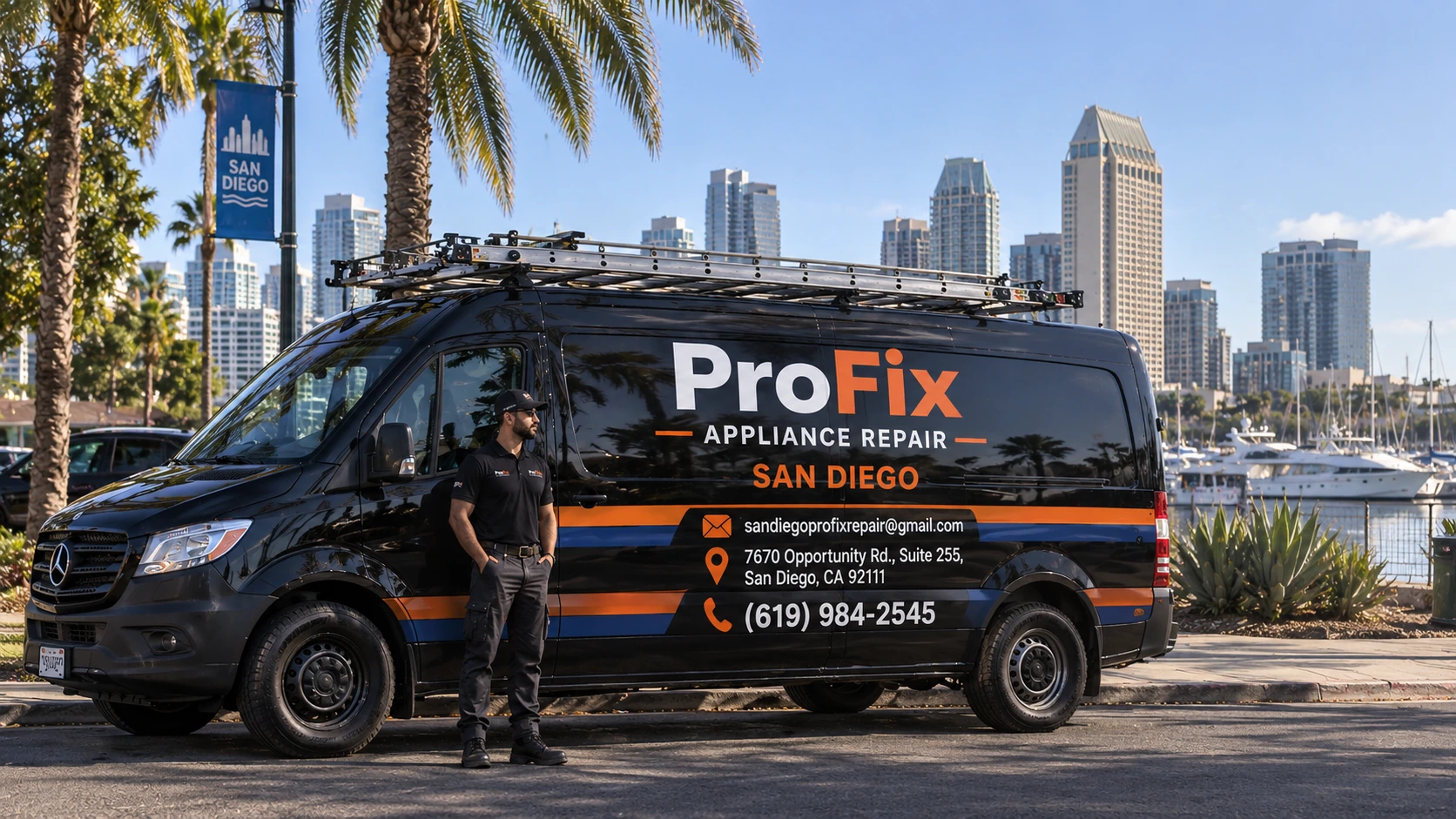
San Diego ProFix Appliance Repair repairs freezers in homes across San Diego County. The technician diagnoses the fault in place, gives you a written estimate before any work starts, and repairs it on site whenever the part is available. We work on Samsung, LG, Whirlpool, GE, Maytag, Bosch and the other brands listed below. We're an independent repair company, so if your freezer is still under the manufacturer's warranty, contact the manufacturer first. Repairs carry a 90-day parts and 30-day labor warranty.
How It Works
San Diego County
Ready to schedule your repair?
San Diego ProFix Appliance Repair: independent, in-home appliance repair with a written estimate before any work starts.
Why a standalone freezer is its own kind of repair
A chest or upright freezer has one job: hold food at 0°F or colder for months at a time. That sounds simpler than a refrigerator, and mechanically it often is, but the stakes are different. A freezer is usually full of bulk meat, fish from a fishing trip, batch-cooked meals or breast milk, and it tends to live in the garage, the laundry area or a back porch where nobody notices a problem until something is soft.
Freezer repair is about two things: catching a fault before the contents thaw, and figuring out whether the freezer itself failed or the place it sits is asking more of it than it was built for. In San Diego County, the second question comes up constantly.
Chest freezers versus upright freezers
Most chest freezers are manual defrost. The cooling tubing is wrapped around the inner liner under the walls, so cold is conducted straight through the sides with no fan inside. Cold air stays put when the lid opens, which is why chests hold temperature well during outages. The trade-off is that frost builds on the walls and has to be removed by hand. Mechanically there is little to go wrong: the compressor, its start relay and overload, a thermostat, the lid gasket, and the condenser, which on many chests is a tube loop hidden inside the outer cabinet walls rather than an exposed coil.
Upright freezers come in two styles. Manual-defrost uprights have cold shelves with refrigerant running through them. Frost-free uprights work like the freezer half of a refrigerator: an evaporator behind a back panel, a fan to circulate air, and a defrost heater, thermostat and timer or board that melt frost on a schedule. Frost-free uprights are easier to live with but have more parts that fail, and when the defrost circuit quits the evaporator chokes with ice and the cabinet slowly warms.
Garage-ready ratings and East County heat
Every freezer is designed for a range of surrounding temperatures, shown as a climate class on the rating label or in the manual. Many standard models assume normal indoor rooms. A garage in Santee or El Cajon on an August afternoon can sit well above that range, and a freezer outside its range runs almost continuously, cycles off on its overload, and slowly loses ground. Some freezers sold as garage-ready are built for a wider band and may handle both hot afternoons and cool nights better.
Heat is not the only garage factor. Dust, lint from a nearby dryer and pet hair settle into condenser coils and fan blades. Rodents chew cords and insulation. Near the coast, a garage freezer's exposed metal, hinges and coil can corrode from salt air, and damp marine-layer mornings put extra moisture in the air every time the lid opens.
Symptoms and what they usually mean
Warm and silent, no light, no hum: check the outlet with a lamp and look for a tripped GFCI, since garage outlets are often GFCI-protected and a single trip can kill the freezer without anyone noticing. Some people plug a freezer into a non-GFCI circuit for this reason; whether that is allowed depends on your local code and wiring, so ask an electrician.
Humming or clicking but not cooling: a compressor that tries to start every few minutes points to the start relay, the overload or the compressor itself. Running constantly while temperature drifts up points to a dirty condenser, a failing condenser fan, a low refrigerant charge or, on frost-free uprights, a blocked evaporator.
Thick ice around the lid or door opening: the gasket is not sealing, the lid is being propped by an overfilled basket, or the cabinet is not level. Ice that keeps coming back weeks after a full defrost confirms a seal problem.
Frost-free upright with a frosted back panel and soft food on the top shelves: a defrost failure. The heater, defrost thermostat or control has stopped melting the evaporator.
Puddle under the unit: a plugged defrost drain on an upright, or a drain plug left open on a chest after defrosting.
What you can check without tools
Put an appliance thermometer in a glass of water in the middle of the freezer for several hours; it is more honest than the built-in display. Make sure the control knob was not bumped. Clear a few inches around the cabinet, unplug it, and vacuum any accessible coil and fan area. Test the lid or door seal with a strip of paper at several points around the opening.
If a chest freezer has heavy frost, defrost it: move food to coolers, unplug it, let the ice melt with the lid open, and dry it before restarting. Never use a sharp tool on the liner, because the cooling tubes run right behind it and a puncture usually ends the freezer's life.
Saving the food while you wait
Keep the lid or door closed. A full freezer generally holds safe temperatures for about 48 hours, and a half-full one for about 24. Group packages together so they keep each other cold, and if you can, add bags of ice. Food that still has ice crystals or reads 40°F or below is usually safe to refreeze, though quality may suffer.
If your area is prone to public-safety power shutoffs, as parts of the backcountry are, a chest freezer that stays shut is the better design. Once power returns, wait a few minutes before plugging the freezer back in so a surge does not reach the compressor or control.
How we handle a freezer call, and when to replace instead
We start with the actual cabinet temperature, the compressor's amp draw and the condenser, then work through relay, thermostat, fan and defrost tests as needed. We give you a written estimate before doing any work, and when the schedule allows, a freezer full of food gets an earlier slot. Freezers still under the maker's warranty should be serviced through the manufacturer, since we are an independent shop. Parts we install carry 90 days of coverage and labor carries 30.
Typical service life for chest and upright freezers is commonly cited in the 10 to 20 year range, with simple manual-defrost chests often at the long end. Relays, thermostats, gaskets, fans and defrost parts are usually worth replacing. A failed compressor or a leak in tubing buried in the walls often costs close to a new freezer, and if the unit is fighting a hot garage, putting the money toward a model rated for that space is frequently the better answer.
Still have questions?
Call or book online and ask us directly. We'll give you a straight answer.