
Oven · All brands
Oven Repair in San Diego
In-home oven repair across San Diego County, from Oceanside to Chula Vista, for every major brand. Same-day visits when the schedule allows.
Or book online and we'll get back to you to set a visit window.
Schedule Your Repair
Four quick steps. We'll confirm a visit window with you, and you'll get a written estimate before any work starts.
Service Type
What type of service do you need?
Or call us directly:
(619) 984-2545Oven Brands We Repair































Repair Service Shaped Around San Diego Homes
San Diego ProFix Appliance Repair repairs ovens and ranges in homes across San Diego County. The technician diagnoses the fault in place, gives you a written estimate before any work starts, and repairs it on site whenever the part is available. We work on Samsung, LG, Whirlpool, GE, Maytag, Bosch and the other brands listed below. We're an independent repair company, so if your oven is still under the manufacturer's warranty, contact the manufacturer first. Repairs carry a 90-day parts and 30-day labor warranty.
How It Works
San Diego County
Ready to schedule your repair?
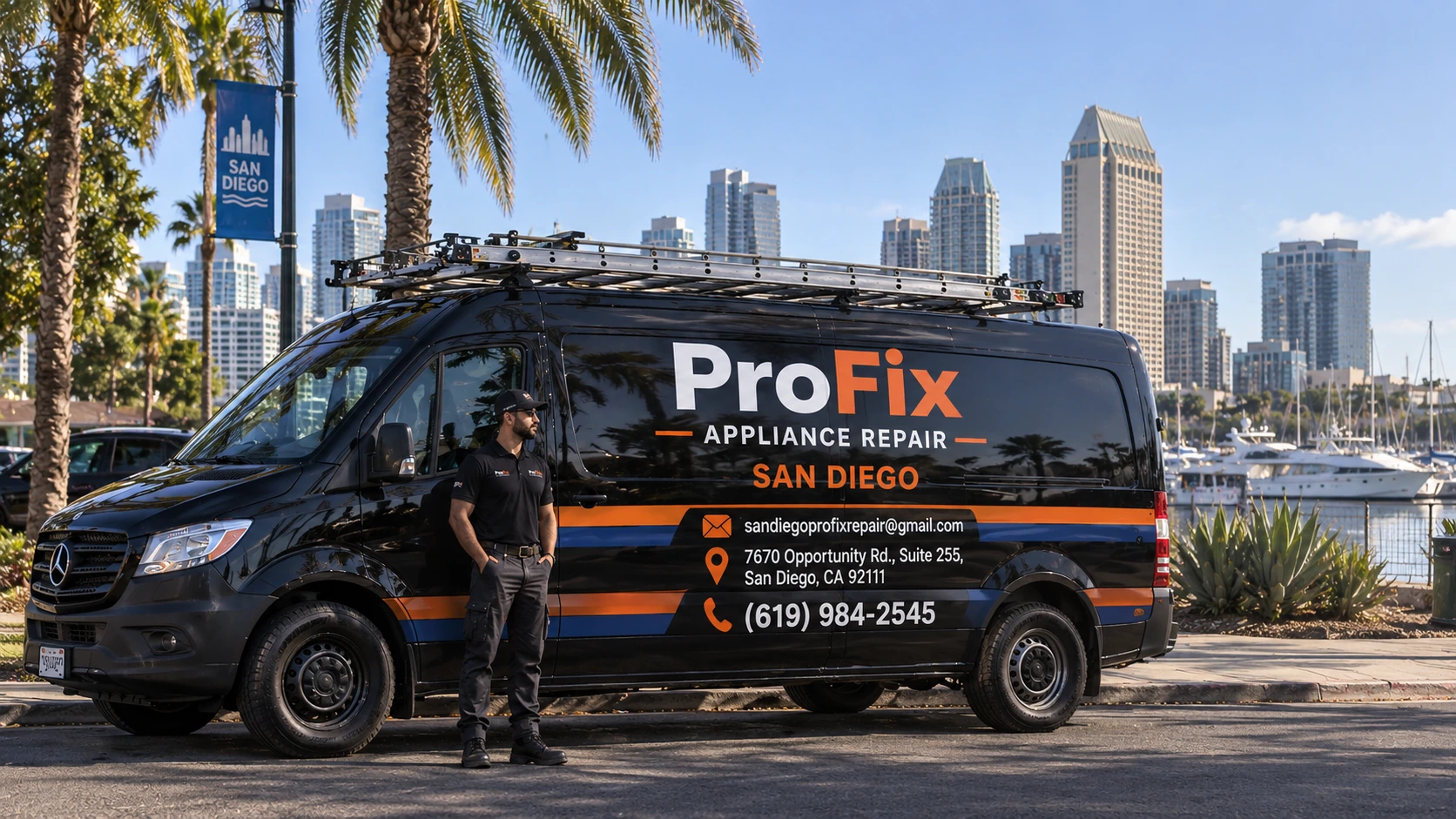
San Diego ProFix Appliance Repair: independent, in-home appliance repair with a written estimate before any work starts.
Oven repair in San Diego starts inside the cavity
An oven is an insulated box with a heat source, a temperature probe and a controller that switches the heat on and off to hold your setpoint. That's true of a freestanding range's lower compartment, a single wall oven, the top and bottom of a double wall oven, and the small second cavity some ranges carry. When people tell us the oven is broken, the trouble almost always lives in one of four places: the heat source, the sensor, the door and lock, or the control that ties them together.
This page is about that cavity. If your problem is the burners or elements on top, our stove and cooktop pages cover those parts in more depth, and the range page deals with the combined appliance as a whole: moving it, the anti-tip bracket, the gas connector and the power cord.
Electric and gas ovens heat in very different ways
An electric oven uses a bake element along the floor (sometimes hidden under the floor panel) and a broil element across the ceiling. During preheat, many models run both, then cycle the bake element to hold temperature. An element that has failed often shows a visible blister, split or bright spot; others look perfect and simply read open on a meter. Convection models add a third element wrapped around a rear fan.
A gas oven is more interesting. It uses a hot-surface igniter, a gray or silver glow bar, wired in series with a safety valve. The valve only opens when enough current flows through the igniter, and that current drops as the igniter ages. So an older igniter can glow orange, look completely healthy, and still not draw enough to open the valve. The result is an oven that glows, never lights, and slowly loses heat, or one that takes a minute or more to light and then preheats very slowly. Testing current draw, not just glow, is how we separate a weak igniter from a bad valve.
Broil on a gas oven uses either a second burner at the top of the cavity or the same lower burner in a drawer below, depending on the design. If bake works and broil doesn't, the broil igniter is the usual answer.
Reading the symptoms: what your oven is telling you
No heat at all on an electric oven: check whether the cooktop works too. If everything is dead, look at the breaker; a double-pole oven breaker can trip on one side only, leaving the clock on and the elements cold. If the display is fine and only the oven is cold, the bake element, a thermal fuse or a relay on the control board are the common causes.
Gas oven won't light, but you can see the igniter glowing: weak igniter in most cases. No glow at all points to the igniter being open, a wiring fault or the control not calling for heat.
Baking runs hot or cold: the temperature sensor, a thin metal probe on the back wall, changes resistance with heat. A sensor that has drifted makes the oven think it's somewhere it isn't. Many controls also allow you to offset the temperature by a few degrees, which is fine for a small drift but hides a failing sensor if the error keeps growing. An oven thermometer on the center rack, read after the oven has cycled a few times, tells you more than one reading right after preheat.
Oven heats unevenly or burns the bottoms: a bake element with a partial failure, a convection fan that isn't spinning, or foil laid on the oven floor or bottom rack, which blocks airflow and can damage the enamel.
Door won't unlock after self-clean or an error code appears: the lock motor, its switch or the board, covered in the next section.
Self-clean: the cycle that finishes off weak parts
Self-clean takes the cavity far above any cooking temperature for hours and locks the door so it can't be opened. That heat bakes food soil to ash, but it also pushes every part around the cavity hard: the thermal fuse, the door lock motor, the sensor, the wiring behind the back panel and the control board above the door. A part that was near the end of its life will often fail during or right after a clean cycle. If your oven quit after self-clean, that timing is not a coincidence.
Practical advice: don't run self-clean the morning of a holiday meal, wipe heavy spills up first so there's less to burn, ventilate the kitchen, and if the door stays locked after the oven has cooled, turn off the breaker for a minute and restore power before calling. That reset clears some stuck lock states. If it doesn't, don't force the door; the latch can break. Many newer ovens also offer a steam or low-heat clean that is much gentler on parts.
Safe checks before you book
Confirm the clock or timer isn't set to delayed start or Sabbath mode, and that the oven isn't locked through the control panel; both look like a dead oven.
On electric models, look at the bake and broil elements with the oven off and cool. A visible break or blister settles the question. Check the breaker panel for a tripped oven breaker.
On gas models, start a bake cycle and watch through the window or bottom vent. Note how long the igniter glows before the burner lights, if it lights at all. That observation saves time at the visit.
If you smell gas that doesn't clear within a few seconds of lighting, turn the oven off, leave the house without flipping switches and call SDG&E or 911 from outside. Don't try to diagnose a gas oven past watching it light. Anything behind the back panel, the board, the valve and the wiring is a job for a technician.
Wall ovens, double ovens and convection fans
Wall ovens are common in La Jolla and Point Loma custom kitchens and in remodeled homes across the county. They raise two issues a freestanding range doesn't. First, many repairs mean sliding the oven out of its cabinet, which takes two people for a double wall oven and requires care with the trim and cabinet face. Second, a wall oven has a cooling fan that pushes air out above or below the door to protect the controls and cabinetry. If that fan fails, the oven may shut itself off mid-bake, the control may show an overheat code, or the cabinet around it may feel hot. That's a repair you want done promptly.
Convection fans fail by seizing, getting noisy or simply not spinning. A fan that squeals at start-up and then quiets down is on its way out. In a double oven, the two cavities usually share a control board, so one cavity failing doesn't always mean the board is fine. Steam ovens add a water tank or supply line and a steam generator; with San Diego's hard water, descaling them on the schedule in the manual matters more than any other habit.
What happens at an oven service visit
The technician confirms the complaint first, usually by running a bake cycle and measuring actual cavity temperature over time. On electric ovens that means testing element resistance and voltage at the element; on gas ovens, measuring igniter current and checking that the valve opens. If there's an error code, it gets traced to the circuit it refers to rather than treated as an instruction to replace the board.
You get a written estimate before any work begins. Common parts such as elements, igniters and sensors are often fitted the same visit; boards, lock assemblies and wall-oven fans may need to be ordered. Parts and labor carry a 90-day parts and 30-day labor warranty. We're an independent repair company, so an oven still under the manufacturer's warranty should go through them first.
After a power outage, especially after a heat-wave outage or a planned shutoff in the backcountry, some ovens come back with a scrambled display or a control that won't respond. Turning the breaker off for a minute sometimes clears it; if not, the board may have taken a surge, and we'll test it before replacing anything.
Repair or replace an oven?
As a general industry range, ovens and ranges typically last around 13 to 18 years, with gas models often at the longer end and electronics-heavy models sometimes shorter. Elements, igniters, sensors and door gaskets are worth replacing on almost any oven that's otherwise sound. A control board on an older oven is the real decision point: if the board is expensive, discontinued or the oven has other worn parts, replacement may make more sense.
Wall ovens tip the scales toward repair, because a new one has to match the existing cutout. If the exact size isn't made anymore, replacement can mean cabinet work on top of the appliance. We'll measure and tell you when that's a factor before you decide.
Still have questions?
Call or book online and ask us directly. We'll give you a straight answer.